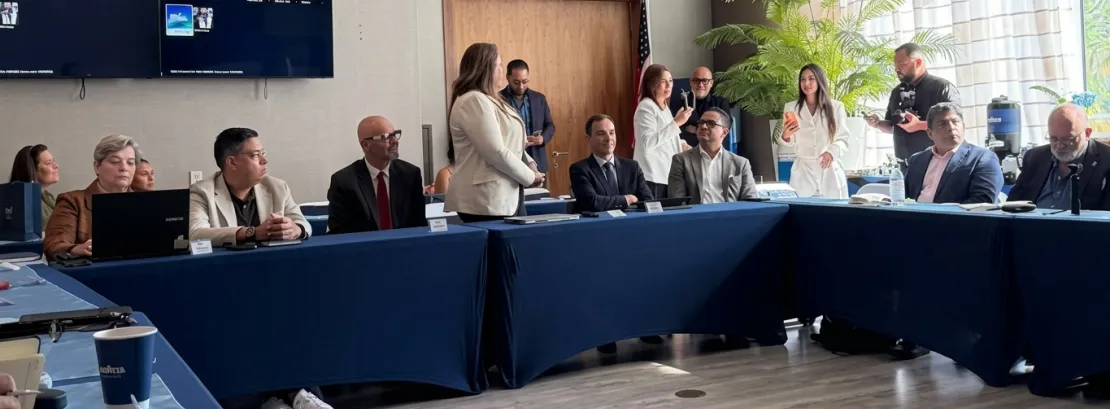
BIU University Celebrates Its First Doctoral Research Colloquium
BIU University held its First Doctoral Research Colloquium 2026, a virtual event featuring an opening keynote and two panels showcasing doctoral research, one for each school. The event centered on a key question: Where does algorithmic assistance end, and where does the responsibility of the researcher begin?
Dr. Olga Mar González, the institution’s Provost, opened the event with remarks on the role of research in university life. “A university should not only transmit knowledge; it should also contribute to generating it,” she stated.
The opening keynote, “Research Mediated by Generative AI: Rigor, Commitment, and Action,” was delivered by Dr. Jacqueline Hurtado de Barrera, a leading authority on research methodology in Ibero-America. The speaker noted that the use of generative AI among researchers increased from 57% in 2024 to 84% in 2025. She warned about the biases, hallucinations, and sycophantic tendencies of these systems, emphasizing that the researcher must remain in control while the tool provides assistance.
The School of Education panel, “Agentic Humanization in Education: Resistance, Relationships, and Digital Territories,” was moderated by Dr. Tomás Fontaine. The university’s doctoral students Joan Manuel Pomares Coello, Mónica Perassi, Vicky Melissa Mirón, and Lady Carolina presented their research. Their dissertations explored faculty resistance to AI as an expression of professional judgment, virtual environments as inhabited territories, the relationship between adult attachment and self-regulated learning, and an accessible instructional design model.
The School of Business panel, “Strategy, Human and Algorithmic Decision-Making: A Perspective from the Digital Financial Landscape,” was moderated by Dr. Daniel Vázquez. Flor de María Caparachín Flores presented her research on financial capability and well-being in Metropolitan Lima; Margarita Minerva Alonso Lavalle examined neuromarketing and online purchasing among Generation Z young adults; and Yober Vargas Figueroa explored social responsibility and financial strategy in hardware retail SMEs in Peru. In his closing remarks, Dr. Vázquez noted that algorithmic decision-making complements human decision-making capabilities and requires oversight and sound validation criteria.
At the closing ceremony, Dr. Eduardo Atencio Bravo, Dean of Research and New Products, brought the event’s key themes together around authorship, evidence, and trust. “Research cannot be decreed; it must be built through transparency,” he stated, presenting the colloquium as the first edition of a journey that is only just beginning.